

Java Training Institute
JAVA
The Java Full Stack Development Course is designed to take learners from Java fundamentals to enterprise-level application development using Spring Boot. The program covers Core Java, Advanced Java, JDBC, Servlets, JSP, Spring Framework, and Spring Boot through practical learning and real-world projects.
Learners gain strong knowledge of object-oriented programming, database integration, REST API development, and backend application design.
By the end of the course, students will be able to design, develop, and deploy full-stack Java applications with confidence.
WHY CHOOSE THIS PROGRAM
Industry-focused Java development curriculum
Covers core Java programming concepts including object-oriented programming, data structures, exception handling, and application development used in modern software environments.
Practical learning with real coding exercises
Work on 5+ coding assignments and 3+ application-based projects to understand how Java is used to build real software solutions.
Instructor-led programming sessions
Includes guided coding sessions where instructors demonstrate Java programming, debugging techniques, and best practices in software development.
Hands-on application development
Build 4+ Java applications using technologies such as Core Java, JDBC, and basic web integration to understand real-world development workflows.
CAREERS IN JAVA
1M+
jobs in India (2026)
$110B+
global market value
90% Large
enterprises use Java
Up to 18 lakhs
avg salary
After completing the course, learners can pursue roles such as:
Java Developer
Java Full Stack Developer
Backend Developer (Java)
Spring Boot Developer
Software Engineer
Web Application Developer
These roles are available in IT companies, startups, product companies, fintech, and enterprise software organizations.
TRAINING CURRICULLUM
Overview of Java: Features, JVM, JRE, JDK
Installing Java & IDE setup (Eclipse/IntelliJ/VS Code)
Writing your first Java program
Data types, variables, operators, and expressions
Input/output using Scanner & console
Control statements: if, switch, loops (for, while, do-while)
Classes, Objects, and Methods
Constructors and Method Overloading
Encapsulation, Inheritance, Polymorphism, Abstraction
Access Modifiers & Packages
thiskeyword,superkeyword, final, static keywords
Arrays, Strings, and StringBuffer/StringBuilder
Collections Framework: List, Set, Map, Queue, and Iterators
Exception Handling: try-catch, throws, throw, custom exceptions
File I/O: Reading and writing files (BufferedReader, FileWriter)
Java Generics
Lambda Expressions & Functional Interfaces (Java 8)
Introduction to Threads and Runnable Interface
Thread Lifecycle & Thread Priority
Synchronization & Inter-thread Communication
Concurrency Utilities: ExecutorService, Callable, Future
Objective: Apply Core Java concepts in a practical scenario.
Example Projects:
Console-based Student Management System
Library Management System
Key Skills: Classes, OOP principles, file handling, exception management
Introduction to JDBC and Database Connectivity
CRUD Operations using JDBC
PreparedStatement vs Statement
Connection Pooling & Transactions
Integrating MySQL/PostgreSQL with Java
Overview of Java EE and Web Architecture
HTTP Protocol, Request & Response
Servlets: Lifecycle, doGet(), doPost(), init(), destroy()
Session Management & Cookies
JSP Basics: Syntax, Directives, Scriptlets
Introduction to Spring Framework & Dependency Injection
Spring IoC Container & Beans
Bean Scopes, Life Cycle, and Autowiring
Configuration with XML and Annotations
Introduction to Spring Boot & Spring Initializr
REST API Design and Development
Controllers, Services, and Repository Layers
Spring Data JPA & CRUD Operations
Exception Handling & Validation in Spring Boot
Connecting Spring Boot to MySQL/PostgreSQL
Spring Security Basics: Authentication & Authorization
JWT (JSON Web Tokens) for API Security
Unit Testing with JUnit & Mockito
Application Logging & Monitoring (SLF4J, Logback)
Deployment Overview: Docker, AWS, or Local Server
Objective: Build a full-fledged enterprise application using Java and Spring Boot.
Example Projects:
Online E-Commerce System (Product Catalog, Cart, Orders)
Employee Management System with Role-Based Access Control
Bank Management System with REST APIs & MySQL Integration
Key Skills: Full-stack development, Spring Boot REST APIs, database integration, security, testing, and deployment
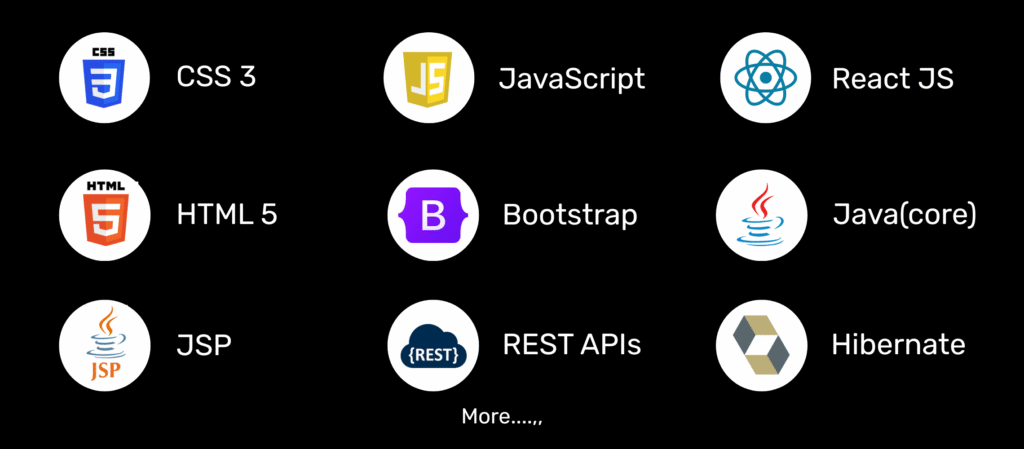
MASTER IN-DEMAND JAVA TOOLS
CAREER SUPPORT

1:1 mentorship from industry experts
Get 1:1 career mentorship from our industry experts to prepare for jobs in AI and ML

Interview prep with experts
Participate in mock interviews and access our tips & hacks on the latest interview questions of top companies

Resume & profile review
Get your resume/cv and LinkedIn profile reviewed by our experts to highlight your AI & ML skills & projects

Access to RagatechSource Job Board
Apply directly to top opportunities from leading companies with our Job Board
DURATION
Course Length: 6 Months
Session Time: Up to 8 hours per day
Includes: Recorded sessions for revision
WHO CAN JOIN
Students or graduates interested in Java development
Beginners who want to learn Java full stack
Professionals looking to upskill in backend development
FREQUENTLY ASKED QUESTIONS (FAQ's)
The Java training course typically runs for 4 months, with structured classroom sessions, hands-on labs, and project-based learning to ensure practical understanding.
Basic knowledge of programming concepts is helpful but not mandatory. This Java Training Institute starts from fundamentals and gradually progresses to advanced full-stack development.
Yes. The course includes mini projects and a final full-stack Java project, allowing learners to apply Core Java, Spring, and Spring Boot concepts in real-world scenarios.
Absolutely. Spring Boot is a key part of the curriculum, covering RESTful API development, security, and enterprise-level application design.
After completing the course at this Java Training Institute, learners can apply for roles such as Java Developer, Backend Developer, Full Stack Java Developer, and Software Engineer.
Yes. The course structure is designed to support both students and working professionals, with guided sessions and access to recorded classes for flexible learning.